
Take a free full-length SAT diagnostic
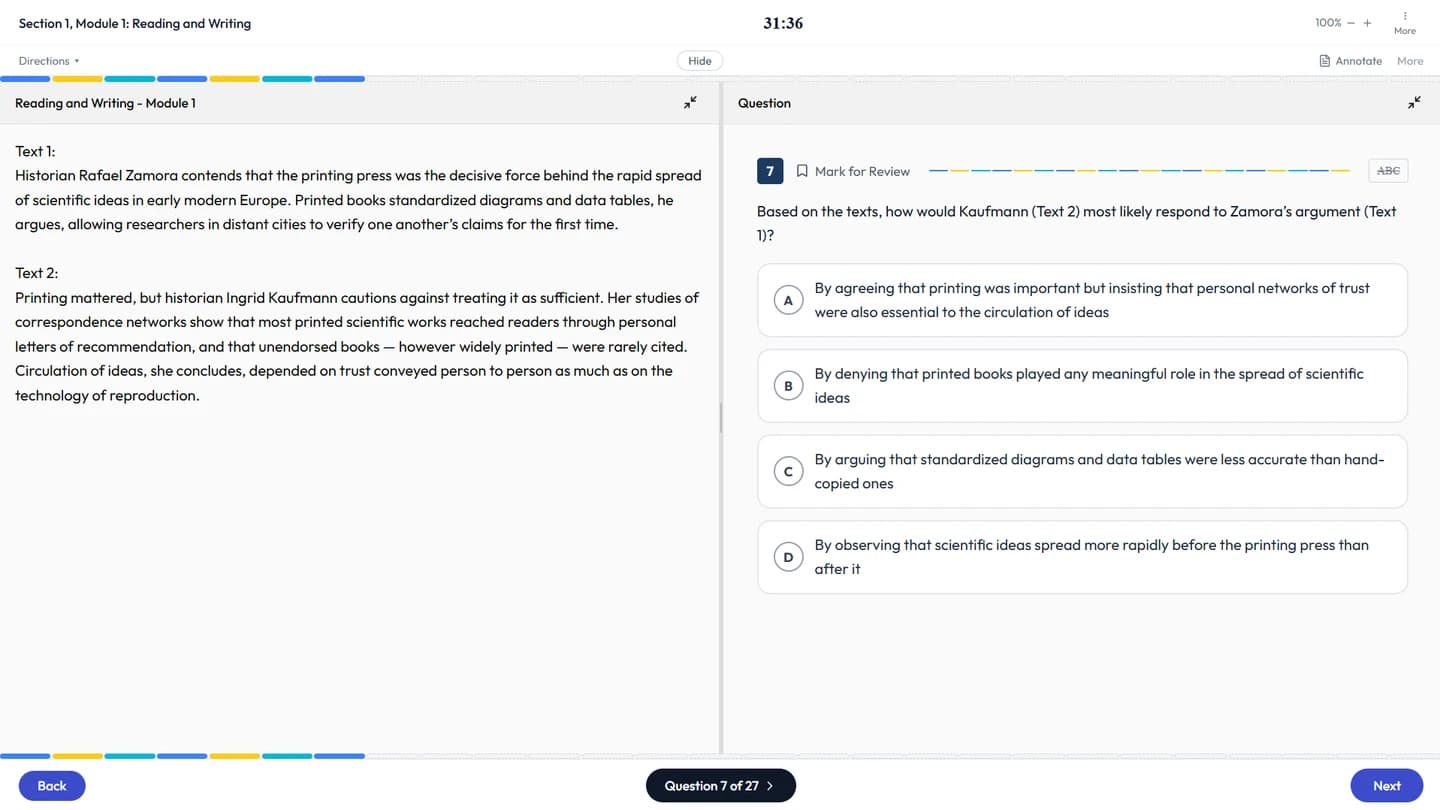
An SAT diagnostic test is a full-length SAT taken under real timing before preparation starts — 98 questions across 2 hours 14 minutes, in the adaptive two-module format. Its purpose is not the score. It is to produce an error profile: which content domains your mistakes cluster in, and whether each mistake came from content you did not know, a method you applied wrongly, or running out of time. On this site the diagnostic is free: you take it in the TestPrep simulator and see the results as soon as you finish.
This matters because two students with the same total score routinely need opposite plans. A 1200 built on a strong Math section and weak Craft and Structure has nothing in common with a 1200 built on solid reading and a collapse in Advanced Math. Put both into the same course and most of the hours are wasted on one of them.
Results the moment you finish
Score and routing
Accuracy by topic
Time per question
Cause and plan, with a tutor
What actually happens
- 1
Create a free account and start
The diagnostic opens in the TestPrep simulator. Full length, real timing, adaptive modules and the standard 10-minute break, in one sitting.
- 2
Read your results
Scores, routing, accuracy by topic and a question-by-question review are ready as soon as you submit.
- 3
Work on the gaps
The question bank filters by domain, skill and difficulty, and your first 30 questions are free. Stuck on a mistake? AI Tutor works it through with you.
- 4
Measure again
20 full-length practice tests are available as paid packs, so each block of work ends with a new measurement.
What is free, and what is paid
- Full-length diagnostic testFree
- Question bank, first 30 questionsFree
- 20 full-length practice testsPaid packs
- Full question bankPaid plans
College Board's own Bluebook practice tests are free too, and worth taking alongside ours.
Where a tutor adds something
The classification step is the hard part to do alone. Students reliably label a question "careless" when the real cause was a method that only works on easy cases, and reliably label a timing failure as a knowledge gap. Getting the cause wrong sends the whole plan in the wrong direction.
Our paid, 90-minute single tutoring lesson includes a diagnostic review and a written study plan. See the single-lesson option and tutoring packages.
AI Tutor talks you through the questions you got wrong
When your SAT practice test ends, pick a mistake on your results page and the lesson starts. The tutor won't just read out the answer: it asks you, writes the steps on the board and lets you find where you went wrong.
Your first 2 mistakes are free (up to 10 minutes)
No card needed to try it, just your account.

Diagnostic test FAQ
Already know your profile? See how a study plan is built from it, or go straight to the TestPrep practice tests.
One test. A real answer about where your score is going.
Take the free diagnostic in our simulator, read the breakdown, and start the actual work knowing what it should be.