
This is a report of a short survey taken at the end of the first lesson of our SAT group course, the class that began on 15 August 2026. 42 students answered it. The figures and the original Google Forms screenshots are below, unchanged. Around them, this page asks a question the survey was not designed for but that most SAT1Prep readers have: if you are preparing for the Digital SAT on your own, what does a good first lesson give a student that you have to find another way?
In brief: 41 of the 42 students rated both their first Math lesson and their first English lesson 4 or 5 out of 5, each lesson averaged 4.79 / 5, no student asked for a different tutor in either subject, and the online platform averaged 4.64 / 5.
How the survey worked
Students got a Google Forms link straight after the first lesson; nobody had to reply. There were five questions in three groups: a 1–5 rating for the first day of Math and of English, a choice for each tutor between keeping them, waiting a week, or asking for someone else, and a 1–5 rating for the online teaching platform. Percentages below are shares of the 42 who replied, which makes each student worth about 2.4%.
Question 1: the first Math lesson
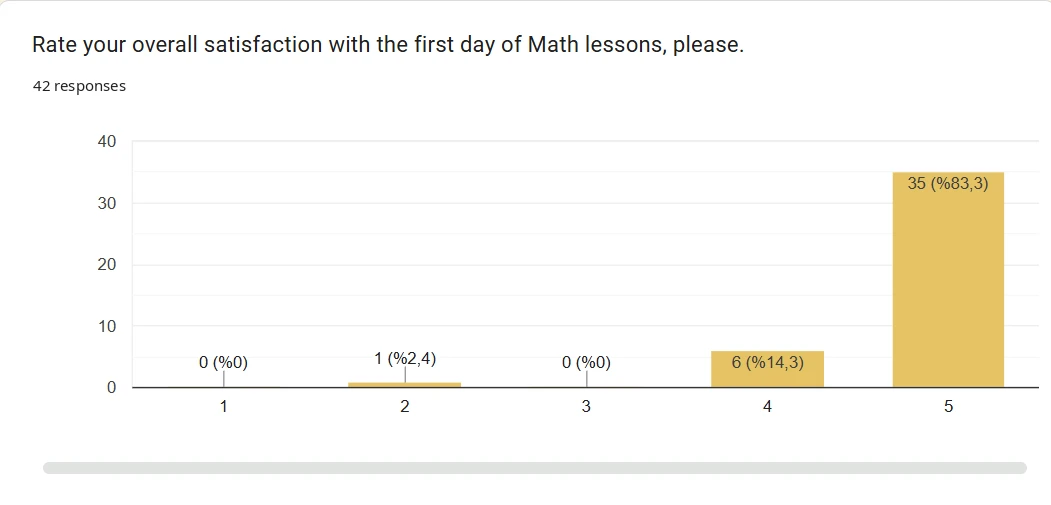
Students were asked: "Rate your overall satisfaction with the first day of Math lessons, please." (1 = lowest, 5 = highest.)
| Rating given | Students | Share of 42 |
|---|---|---|
| 5 | 35 | 83.3% |
| 4 | 6 | 14.3% |
| 3 | 0 | 0% |
| 2 | 1 | 2.4% |
| 1 | 0 | 0% |
Average: 4.79 / 5. Put the other way round, one student in 42 marked the Math start below 4, with a 2, and no one used a 1 or a 3.
If you study alone. A taught course gives you a starting point: someone else decides what the first Math lesson covers. On your own, nobody hands you that starting point. The nearest equivalent is a full-length, timed test taken before any revision, so that your Math score is broken down by domain and skill instead of guessed at. Our free Digital SAT diagnostic does exactly that, and it is the step to take before you open a single topic.
Question 2: keeping the Math tutor
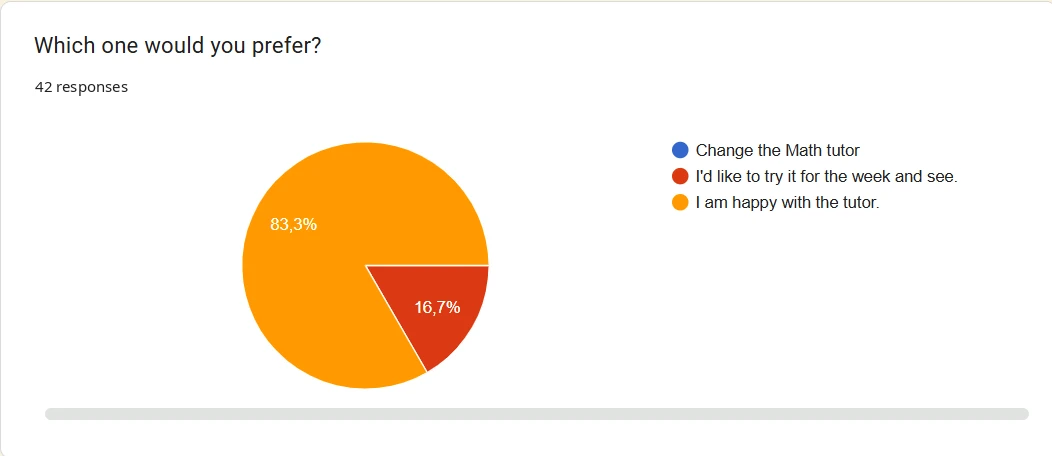
The form asked "Which one would you prefer?" and offered I am happy with the tutor, I'd like to try it for the week and see and Change the Math tutor.
| Answer chosen | Students | Share of 42 |
|---|---|---|
| Happy with the tutor | 35 | 83.3% |
| Try it for the week and see | 7 | 16.7% |
| Change the tutor | 0 | 0% |
Seven students, 16.7%, held back their verdict for a week, and none wanted a change.
If you study alone. Those seven did something worth copying: they judged the arrangement on a week of real work rather than on one session. A self-taught plan deserves the same test. After a week, sit a practice test and sort every wrong answer by why it went wrong, not only by topic. A plan that is working moves the errors; one that is not leaves the same causes in the same places. The error analysis method explains the four causes and how to tell them apart.
Question 3: the first English lesson
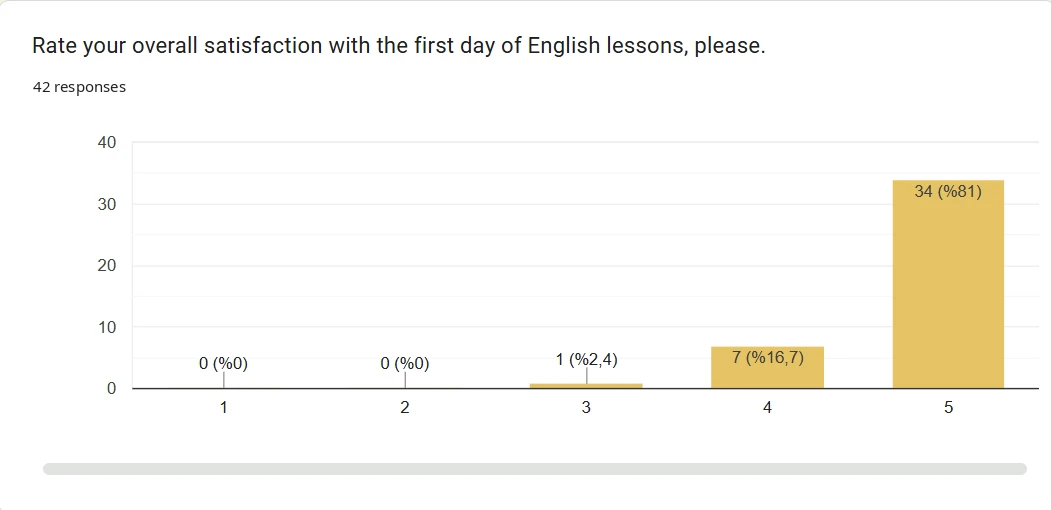
The wording was: "Rate your overall satisfaction with the first day of English lessons, please."
| Rating given | Students | Share of 42 |
|---|---|---|
| 5 | 34 | 81% |
| 4 | 7 | 16.7% |
| 3 | 1 | 2.4% |
| 2 | 0 | 0% |
| 1 | 0 | 0% |
Average: 4.79 / 5, the same figure as Math. Again 41 of the 42 gave a 4 or a 5; the one lower mark here was a 3.
If you study alone. "English" in the course is the Reading and Writing section, and it is the half of the test that self-study most often treats as practice volume: more passages, more questions. Every Reading and Writing question carries its own short text, so the useful question is which kinds of question you miss and why. Our Reading and Writing guide sets out the four domains, and the question bank lets you practise one skill at a time once you know which one it is.
Question 4: keeping the English tutor
| Answer chosen | Students | Share of 42 |
|---|---|---|
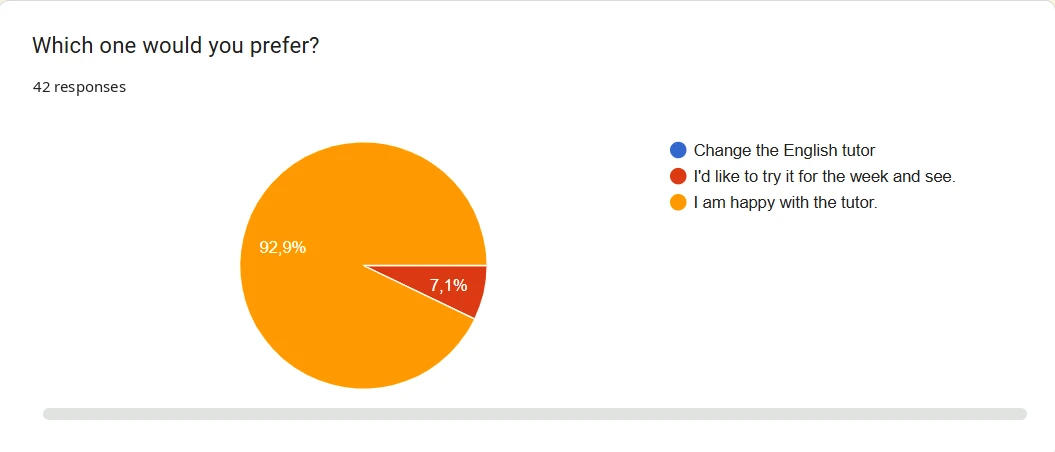
| Happy with the tutor | 39 | 92.9% |
| Try it for the week and see | 3 | 7.1% |
| Change the tutor | 0 | 0% |
Here 39 of 42 (92.9%) chose to stay and 3 (7.1%) wanted a week to decide; again, no request for someone else. More students chose to keep the English tutor than the Math tutor: 92.9% against 83.3%.
Question 5: the online teaching platform
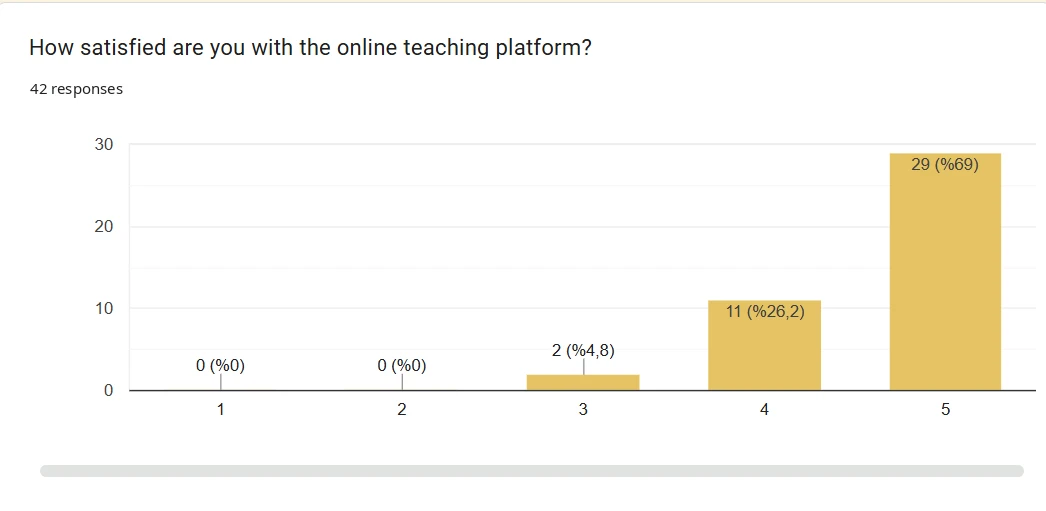
The last question read: "How satisfied are you with the online teaching platform?"
| Rating given | Students | Share of 42 |
|---|---|---|
| 5 | 29 | 69% |
| 4 | 11 | 26.2% |
| 3 | 2 | 4.8% |
| 2 | 0 | 0% |
| 1 | 0 | 0% |
Average: 4.64 / 5, with 40 of the 42 at 4 or above and two students at 3. Of the three averages, it is the lowest.
If you study alone. The tool matters for you too, for a different reason. The Digital SAT is sat in College Board's Bluebook app, in two modules per section, and the second module depends on how the first went. Practise in something that behaves the same way, so that pacing and the move between modules are familiar on the day. Our full-length practice tests are built to that format, and College Board's own tests in Bluebook are free.
The five answers side by side
| Survey question | Top answer | Next answer | Anything lower | Mean |
|---|---|---|---|---|
| First day, Math | 5 points: 35 (83.3%) | 4 points: 6 (14.3%) | 2 points: 1 (2.4%) | 4.79 / 5 |
| Math tutor | Happy: 35 (83.3%) | A week to decide: 7 (16.7%) | Change: 0 | – |
| First day, English | 5 points: 34 (81%) | 4 points: 7 (16.7%) | 3 points: 1 (2.4%) | 4.79 / 5 |
| English tutor | Happy: 39 (92.9%) | A week to decide: 3 (7.1%) | Change: 0 | – |
| Teaching platform | 5 points: 29 (69%) | 4 points: 11 (26.2%) | 3 points: 2 (4.8%) | 4.64 / 5 |
What a first-day survey can and cannot show
These answers describe how one group felt at the end of its first day. They say nothing yet about scores, and we do not read them as a forecast of anyone's result. They describe the start of a course, and that is all this page uses them for.
If you are weighing a course against preparing by yourself, start with the same thing either way: an honest measurement of where you stand.
Start with a diagnostic to find out which of these applies to you, or see how tutoring works.